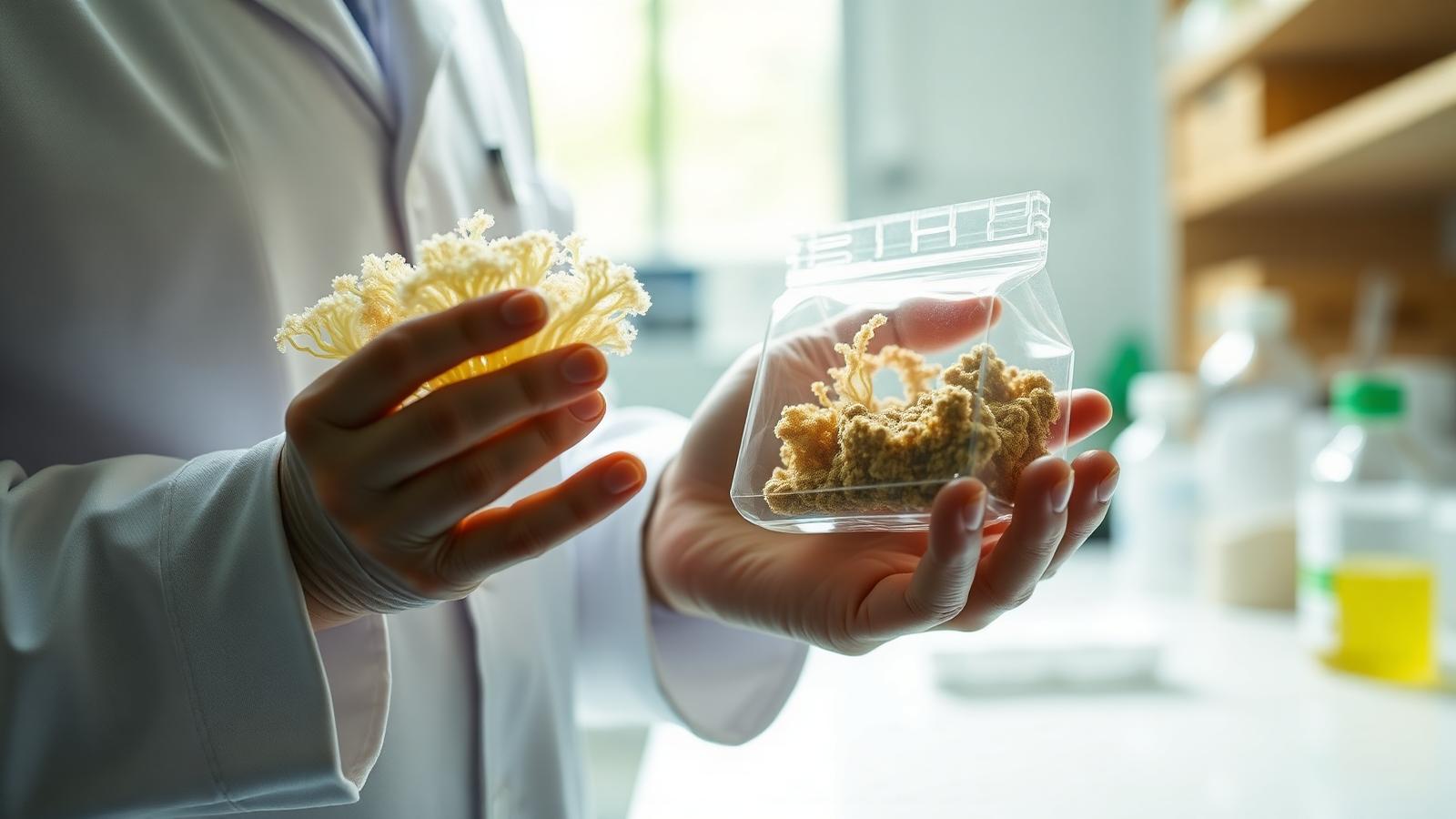
Mycelium packaging
Home-compostable in 45 days, replacing expanded polystyrene in shipping and food service.
Invention that changes what an entire industry considers possible.
Recipients of this recognition receive the official Ecopulsive Sustainable Innovation Award Winner banner for use across their website, packaging, social media, email signatures, marketing materials, reports and presentations. The banner must always be displayed complete and unaltered, with the Ecopulsive logo, award category and award year intact.
Read the banner usage guidelinesSustainable Innovation is the category built for companies that are not simply adjusting their marketing language to sound greener, but are fundamentally rethinking how a product, service or process is designed, built or delivered so that its environmental footprint is meaningfully smaller than the status quo it replaces.
It is the most forward-facing of the six pillars, because it rewards the kind of work that changes what is possible for an entire industry, not just what one company does internally. Where Green Operations looks at how a business runs day to day, and Circular Economy Leadership looks at how materials flow after a product's first use, Sustainable Innovation is squarely about invention: new materials, new business models, new technology stacks, or new delivery mechanisms that did not exist — or were not commercially viable — until this company built them.
The clearest examples come from material science and energy. Consider a company that has developed a mushroom-mycelium-based packaging material that fully biodegrades in a home compost bin within 45 days, replacing expanded polystyrene in shipping and food service. That is Sustainable Innovation in its purest form: a genuine substitution for an entrenched, high-volume, environmentally costly material, with a measurable end-of-life benefit that didn't exist in the previous solution.
Similarly, a battery-recycling technology firm that has developed a hydrometallurgical process to recover lithium, cobalt and nickel from spent electric-vehicle batteries at 95%+ purity — material that can be fed directly back into new battery production rather than being landfilled or shipped overseas for inefficient processing — represents the same spirit: solving a scaling problem with a technical breakthrough that has real, auditable numbers behind it.
Energy is the other obvious home for this category. A startup building modular, containerised green hydrogen electrolyzers that can be deployed at ports or industrial sites to displace diesel generators is Sustainable Innovation. So is a solar company that has engineered bifacial panels capable of capturing reflected light from the ground as well as direct sunlight, meaningfully increasing energy yield per square metre of installed capacity without requiring new land. In both cases, the innovation is not "we care about the environment" — it is a specific, defensible technical claim: this generates X% more energy, or displaces Y tons of diesel combustion per year.
Food and agriculture provide another rich vein of examples. A company producing plant-based protein that requires a fraction of the land, water and greenhouse gas emissions of the animal protein it displaces fits cleanly into this category — provided the environmental claims are backed by lifecycle assessment data rather than assumption.
A vertical farming company using 95% less water than traditional agriculture to grow leafy greens in urban warehouses, powered by renewable energy and LED grow lights tuned to plant-specific wavelengths, is another strong fit. It is inventing a new supply chain geography — grow food inside cities, not hundreds of miles away — with a quantifiable resource-use case.
Evaluators assessing applicants look for three things. First, a clear "before and after" comparison: what did companies do before this innovation existed, and what does this innovation change. Second, quantifiable impact metrics — tons of CO2 avoided, litres of water saved, percentage reduction in resource intensity — ideally validated by a third party or grounded in a recognised methodology such as an ISO-certified life-cycle assessment. Third, evidence of scalability or commercial traction, since a brilliant lab prototype that will never reach market has a different kind of value than one already displacing carbon-intensive alternatives in the real economy.
For a company applying under this category, the strongest applications tell a specific story: here is the problem in this industry, here is what existed before us, here is what we built, and here are the numbers that prove it works. Vague claims of being "eco-friendly" or "green by design" without supporting data will struggle against applicants who can point to third-party verification, patents, published life-cycle assessments, or independently audited emissions reductions.
"This startup turns discarded EV batteries into new battery-grade lithium — recovering 95% of the metal that used to end up in landfill" does more work in a feed than three sentences of aspirational language. Lead with the breakthrough in plain language, then the number that proves it matters.
These are illustrative industry cases used to explain the category. They are not Ecopulsive awardees or affiliates.
Home-compostable in 45 days, replacing expanded polystyrene in shipping and food service.
Lithium, cobalt and nickel recovered at 95%+ purity and fed straight back into new cell production.
Modular electrolyzers deployed at ports and industrial sites to displace diesel generators.
Captures reflected ground light as well as direct sun, raising yield per square metre with no extra land.
A fraction of the land, water and emissions of the animal protein it displaces — proven by LCA.
95% less water, renewable-powered LEDs, and a supply chain that starts inside the city.
Ecopulsive issues verifiable recognition certificates backed by transparent criteria. Tell us what you built and the numbers behind it.