
Mangrove storm buffers
Restored coastal habitat that absorbs surge, stores carbon and nurses marine life.
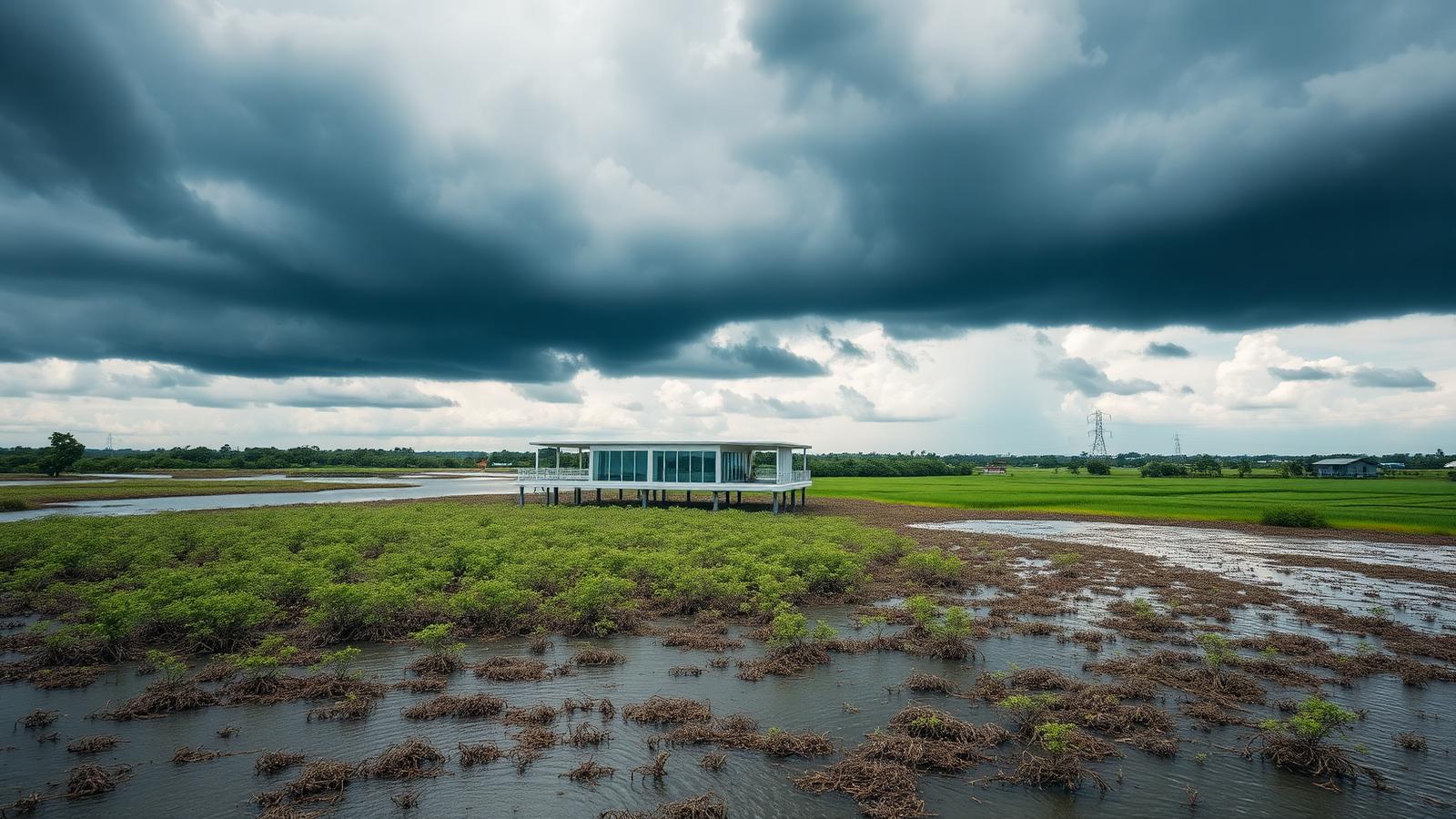
Adaptation planned ahead of disruption — and built with nature, not against it.

Recipients of this recognition receive the official Ecopulsive Climate Resilience Award Winner banner for use across their website, packaging, social media, email signatures, marketing materials, reports and presentations. The banner must always be displayed complete and unaltered, with the Ecopulsive logo, award category and award year intact.
Read the banner usage guidelinesClimate Resilience is the forward-looking category among the six, distinct in that it is not primarily about reducing an organisation's own emissions or waste, but about adapting operations, infrastructure and business models to withstand and recover from the physical impacts of a changing climate — while doing so in a way that protects, rather than degrades, surrounding ecosystems.
Where the other categories largely address mitigation — reducing the causes of climate change — this category addresses adaptation: managing consequences already underway or increasingly likely. It rewards organisations for planning ahead of disruption rather than reacting after the fact.
Coastal and flood adaptation provides some of the most compelling examples. A coastal developer that designs new construction with elevated foundations, permeable paving to manage stormwater and — critically — restores or preserves adjacent mangrove or wetland areas as a natural buffer against storm surge and erosion demonstrates resilience that also supports the ecosystem doing the protective work. Mangroves in particular are documented as highly effective, low-cost storm buffers compared to engineered seawalls, while also serving as carbon sinks and marine nursery habitat — a rare case where adaptation, ecosystem protection and sequestration reinforce one another.
Agricultural adaptation is increasingly urgent as rainfall patterns shift and growing seasons become volatile. A producer that has transitioned meaningful acreage to drought-resistant varieties, paired with precision drip irrigation that sharply reduces water use per unit of yield compared with flood irrigation, demonstrates practical, on-the-ground adaptation. Regenerative practices — cover cropping, reduced tillage, diversified rotations — improve soil water retention and resilience to both drought and flooding, with the added benefit of long-term soil carbon storage.
Water utility and municipal infrastructure resilience is less visible but critical. A utility investing in modernised stormwater management — larger-capacity drainage, green infrastructure such as bioswales and permeable surfaces that slow and filter runoff, and updated flood modelling that accounts for more intense rainfall than historical design standards assumed — protects both public safety and downstream water quality. It also demonstrates that resilience is not only a coastal or agricultural concern; it is a core competency for infrastructure operators everywhere.
Business continuity planning tied specifically to climate risk is more operational, and highly relevant to manufacturers and logistics companies with geographically concentrated supply chains. A company that has conducted a formal climate risk assessment of its facilities and supplier network — identifying which sites are most exposed to flooding, extreme heat, wildfire or water scarcity — and developed specific contingency plans such as alternative suppliers, facility hardening or insurance restructuring, shows institutional seriousness that goes beyond public messaging. This work often happens quietly inside risk and operations functions and rarely gets external recognition, which is precisely why it belongs here.
Urban heat mitigation is growing in relevance for businesses in cities facing worsening heat waves. A property owner investing in reflective or green roofing, expanded tree canopy on and around its properties, and building design that reduces reliance on energy-intensive air conditioning during extreme heat is addressing a climate risk that is already a leading cause of climate-related mortality in many cities — with concrete physical interventions rather than statements of concern.
Strong applications demonstrate a clear-eyed assessment of specific physical climate risks relevant to the applicant's operations or location, paired with concrete, funded interventions rather than general statements of concern.
The strongest typically show a "risk identified, action taken, outcome measured" structure — for example, a specific flood event that previously caused disruption, the infrastructure investment made in response, and evidence (a subsequent storm weathered successfully, reduced downtime, avoided damage) that the investment worked as intended.
Resilience stories work best when they connect a specific, memorable event — a named storm, a documented drought year, a heat wave — to the concrete adaptation taken in response, grounding an abstract topic in something recent and locally recognisable.
These are illustrative industry cases used to explain the category. They are not Ecopulsive awardees or affiliates.
Restored coastal habitat that absorbs surge, stores carbon and nurses marine life.
Raised foundations and permeable paving that keep stormwater moving, not pooling.
Resilient varieties and precision irrigation cutting water per unit of yield.
Cover crops and reduced tillage improving water retention against drought and flood.
Drainage designed for today's rainfall intensity, not last century's.
Exposure mapped across sites and suppliers, with funded contingency responses.
Ecopulsive issues verifiable recognition certificates backed by transparent criteria. Tell us what you built and the numbers behind it.