
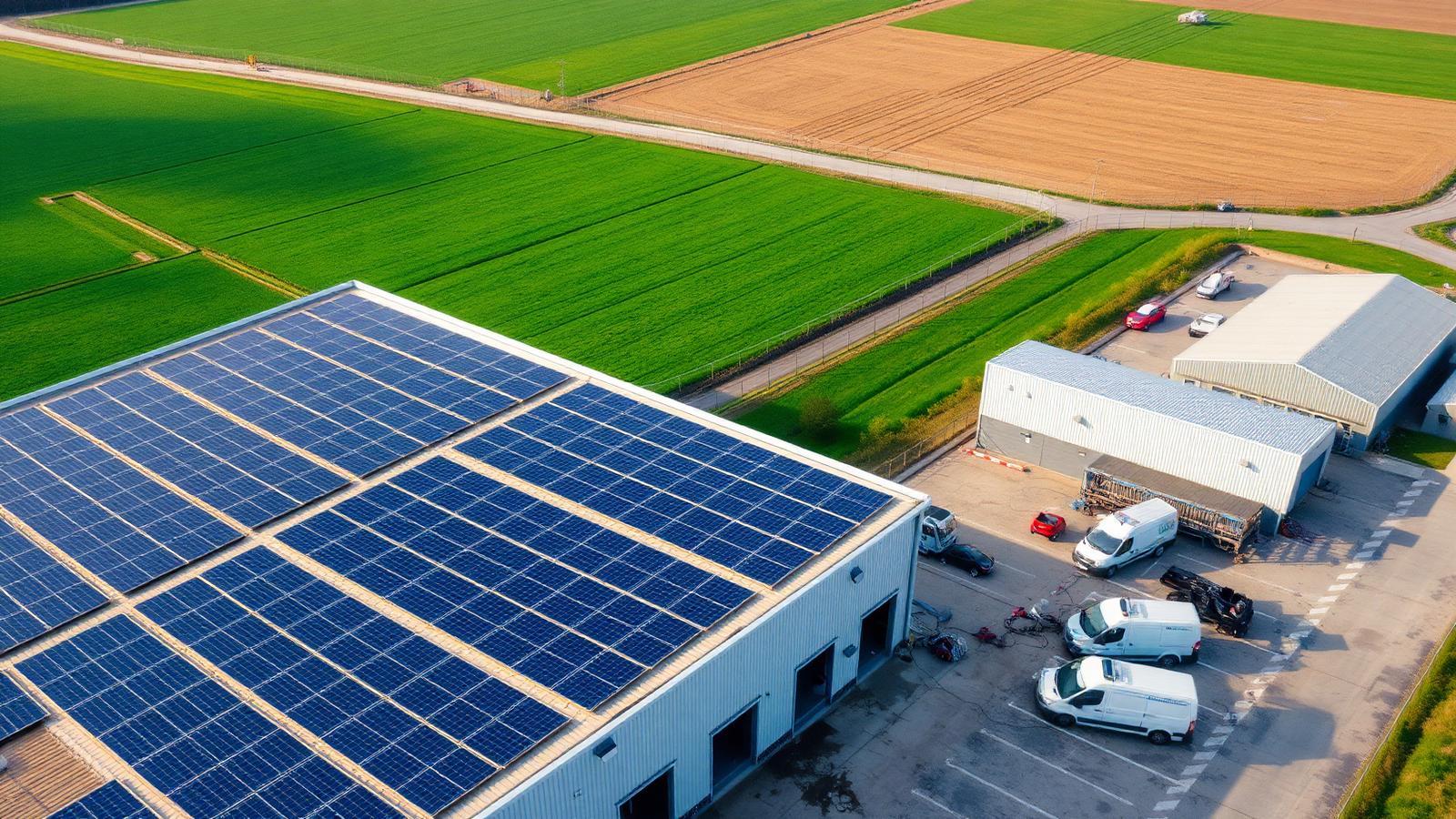
2.4 MW rooftop solar
62% of annual production energy demand, verified by utility interconnection metering.
Not what a company sells — how it runs, measured in kWh, litres and tons.

Recipients of this recognition receive the official Ecopulsive Green Operations Award Winner banner for use across their website, packaging, social media, email signatures, marketing materials, reports and presentations. The banner must always be displayed complete and unaltered, with the Ecopulsive logo, award category and award year intact.
Read the banner usage guidelinesGreen Operations is the category concerned not with what a company sells, but with how it runs. It rewards organisations that have embedded energy efficiency, renewable energy adoption and low-carbon practices directly into day-to-day operations — the facilities they occupy, the fleets they run, the energy they consume, and the processes they use to make or move things.
This is a deliberately internal-facing category: a company could sell a product with no environmental benefit whatsoever and still qualify strongly here, because the recognition is about operational discipline and infrastructure investment. It is, in some ways, the most universally applicable category — almost any business has operations that can be made more or less carbon-intensive.
The most tangible example is on-site renewable generation. A manufacturing facility with rooftop or ground-mounted solar covering a significant share of production energy — sometimes paired with battery storage to smooth supply outside daylight hours — is a textbook case. What separates a strong application from a weak one is specificity: "we use solar power" is weak; "our facility's 2.4 MW rooftop array supplies 62% of annual production energy demand, verified through utility interconnection metering" is strong, because it gives evaluators and audiences something concrete to trust.
Fleet electrification is equally visible, particularly for logistics, delivery and field-service businesses. A regional delivery company that has replaced diesel vans with electric vans, supported by depot-based charging, and can point to a specific reduction in fleet-wide fuel consumption and tailpipe emissions, exemplifies this category. A 40-van regional courier making that transition is arguably a more inspiring example than a global giant, because it shows the transition is achievable without enormous capital.
Facility efficiency retrofits are less glamorous but equally valid: a comprehensive LED retrofit across warehouse and office space, paired with smart HVAC controls that cut heating and cooling loads during unoccupied hours, with a demonstrated year-over-year reduction in total facility energy consumption. Data centres are the high-stakes version — a hosting company achieving a Power Usage Effectiveness rating close to the theoretical ideal of 1.0 through liquid cooling, free-air cooling or waste-heat recovery is doing serious Green Operations work even with no "green" branding attached.
Carbon accounting and offsetting belong here too, but evaluators should apply real scrutiny. A company that achieves verified neutrality through genuine operational reductions — the bulk of the effort — supplemented by high-quality, third-party-verified offsets for the residual portion is a far stronger candidate than one relying primarily on offset purchases while changing little operationally. The credibility of Green Operations claims depends on this distinction, and strong applicants are transparent about the ratio.
Water use is frequently overlooked outside obviously water-intensive industries. A textile dyeing facility with closed-loop water recycling that reduces freshwater intake per unit of fabric by a verifiable percentage, or a food and beverage manufacturer reusing water in cleaning and cooling, represents Green Operations excellence in a dimension that matters enormously in water-stressed regions.
The strongest applications share a few traits: specific, auditable metrics (kWh, MWh, litres, tons of CO2e, percentage reductions) tied to a defined baseline year; evidence of third-party verification or utility and meter-based data rather than self-reported estimates; and ideally a trend showing sustained improvement over multiple years rather than a single one-time upgrade.
This category suits behind-the-scenes storytelling: the solar array, the fleet charging overnight, the retrofit in progress — each paired with the specific number it produced. Green Operations content builds trust precisely because it is unglamorous and mechanical; it reads as real investment rather than marketing.
These are illustrative industry cases used to explain the category. They are not Ecopulsive awardees or affiliates.
62% of annual production energy demand, verified by utility interconnection metering.
Diesel vans retired, fleet-wide fuel use and tailpipe emissions reported before and after.
Loads cut during unoccupied hours, with year-over-year facility energy reduction.
Liquid or free-air cooling and waste-heat recovery pushing PUE toward 1.0.
Freshwater intake per unit of fabric cut by a verified percentage.
Operational cuts do the heavy lifting; verified offsets cover only the residual.
Ecopulsive issues verifiable recognition certificates backed by transparent criteria. Tell us what you built and the numbers behind it.